
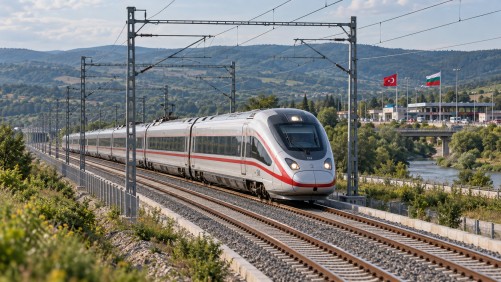
Türkiye has inaugurated a pivotal extension of its high-speed rail network, linking Çerkezköy, just west of Istanbul, to Kapıkule on the Bulgarian border. This 153-kilometer section is a significant part of the 229-kilometer Halkalı-Kapıkule railway line and aims to enhance Türkiye’s connectivity with European markets. President Recep Tayyip Erdoğan, who attended the opening ceremony in Kırklareli province alongside EU Enlargement Commissioner Marta Kos, emphasized that the new railway would bolster the country’s transport infrastructure and support export ambitions.
The project integrates the provinces of Tekirdağ, Kırklareli, and Edirne into Türkiye’s high-speed rail network, increasing the reach to 14 provinces. It includes the construction of modern station buildings in Babaeski, Lüleburgaz, and Büyükkarıştıran, along with the refurbishment of the Kapıkule and Edirne stations. This development is expected to significantly reduce travel times for both passengers and freight, with passenger journeys between Halkalı and Kapıkule dropping from four hours to approximately 1.5 hours, and freight transit times decreasing from 8.5 hours to 3.5 hours.
Türkiye’s Transport and Infrastructure Minister Abdulkadir Uraloğlu highlighted the railway’s role in strengthening ties between Türkiye and the European Union. The railway, jointly financed by Türkiye and the EU, is also a part of the broader Trans-European Transport Network and is set to support the Middle Corridor—a trade route linking Asia and Europe through Central Asia, the Caucasus, and Türkiye. This improved infrastructure is anticipated to enhance connections between European markets and industrial hubs in Istanbul, Kocaeli, Tekirdağ, and the broader Thrace region, as well as nearby ports.
Looking ahead, Türkiye plans to further expand its railway network, which currently spans 13,919 kilometers, including 7,274 kilometers of electrified lines. Construction is underway on an additional 4,858 kilometers, with the goal of reaching a total of 28,590 kilometers by 2053. The government views these investments in rail infrastructure as crucial for improving logistics, boosting international trade, and expanding connections between Europe and Asia.