
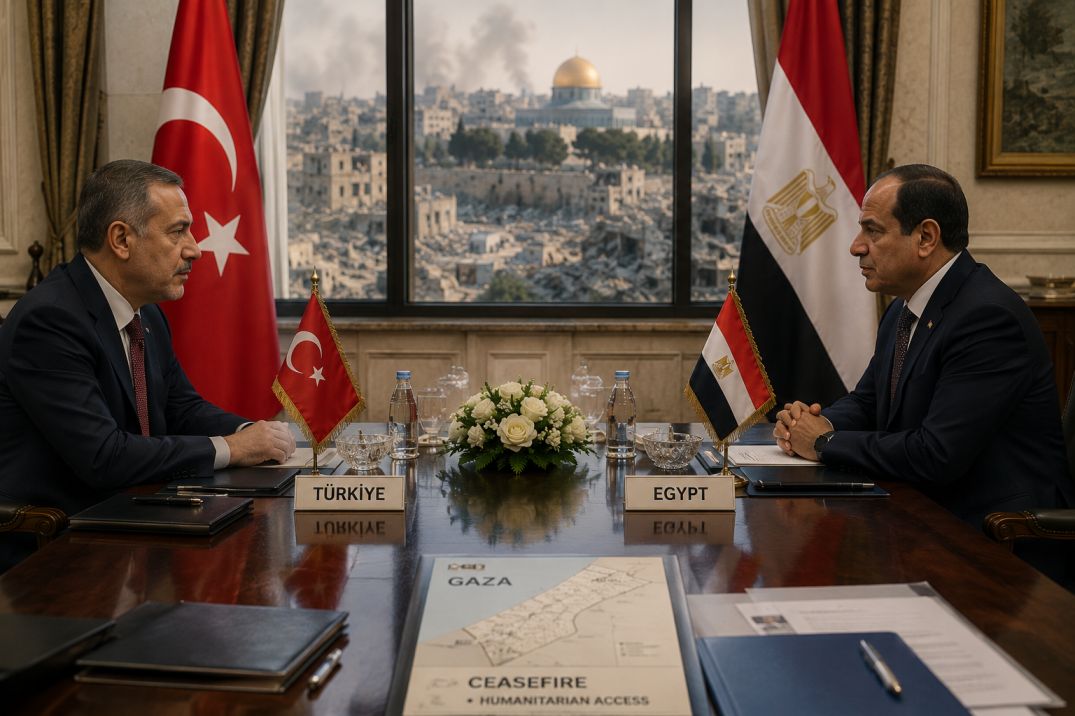
Ibrahim Kalın, the director of Türkiye’s National Intelligence Organization (MIT), convened with Hassan Rashad, head of the Egyptian General Intelligence Service, in Ankara on Monday. This high-level meeting centered on discussions about the Gaza ceasefire, as well as enhancing bilateral cooperation and addressing pressing regional security issues. The dialogue signifies an increasing alignment between Ankara and Cairo as they both aim to fortify diplomatic and security relations across the Middle East and Africa.
The discussions placed a significant emphasis on advancing the second phase of the Gaza ceasefire agreement. Turkish security sources revealed that both officials concurred on the need to bolster coordination to counter what they view as escalating breaches of the ceasefire by Israel. Kalın reiterated Türkiye’s unwavering support for the Palestinian cause, emphasizing Ankara’s commitment to providing aid amid the ongoing conflict.
Beyond the context of Gaza, the meeting allowed the intelligence leaders to assess broader regional developments and explore pathways to deepen cooperation between Türkiye and Egypt. Their agenda included deliberations on promoting political reconciliation in Libya by advocating for the unification of the nation’s governmental institutions and military forces across its eastern and western divisions under a cohesive national administration.
The dialogue also encompassed security challenges elsewhere in the region. Kalın and Rashad exchanged insights on the unfolding situation in Somalia and the conflict in Sudan, involving the Sudanese Armed Forces and the Rapid Support Forces. They evaluated the broader ramifications of these crises on regional stability and considered avenues for ongoing dialogue on mutual security concerns.
The talks highlight the strengthening partnership between Türkiye and Egypt following the renewal of diplomatic relations. As both nations aspire to exert greater influence in resolving regional conflicts, sustained intelligence cooperation is anticipated to be a crucial component of their wider efforts to foster stability, particularly in Gaza and other areas grappling with enduring security challenges.