
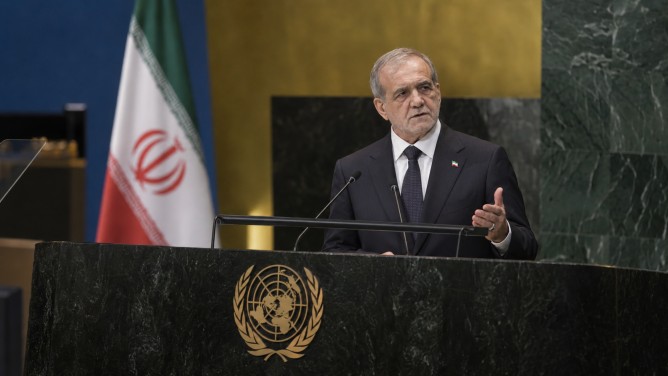
Iran’s commitment to assert its international stance could intensify ongoing geopolitical tensions, as President Masoud Pezeshkian prepares to address the United Nations General Assembly in New York. His pledge to robustly defend Iran’s interests underscores the nation’s determination to navigate a fraught Middle Eastern landscape and a contentious dispute over the strategic Strait of Hormuz, a vital corridor for global energy shipments.
Prior to his departure, Pezeshkian emphasized Iran’s resolve to protect the rights and interests of its citizens on the global stage. This assertion comes at a time when diplomatic relations in the region remain strained, partly due to Iran’s conditions for reopening the Strait of Hormuz, through which a significant portion of the world’s oil and gas is transported. Meanwhile, the United States continues to impose measures that affect Iranian ports, adding another layer of complexity to the situation.
Foreign Minister Abbas Araghchi, already in New York, is leading Iran’s diplomatic delegation at the UN gathering. His discussions with UN Secretary-General Antonio Guterres centered on the General Assembly’s agenda, with Iran aiming to leverage this international platform to emphasize what it views as the legitimacy of its national interests. Araghchi’s diplomatic engagements are expected to include meetings with various foreign ministers and officials attending the session, aiming to rally support or understanding of Iran’s positions amid these tensions.
The backdrop of Iran’s participation in the General Assembly is marked by the broader Middle Eastern conflict and U.S. sanctions, which continue to shape the regional dynamics. Iran’s strategic maneuvers, including diplomatic overtures through Qatar regarding the Strait of Hormuz, reflect its broader strategy to assert influence and safeguard its economic and security interests under international scrutiny.